

The Diplomat 2.0: An Indispensable Actor in the Reconfiguration of Contemporary Diplomacy
The Diplomat 2.0 has become an indispensable player in the Reconfiguration of Global Diplomacy. The current international landscape, though formally multilateral, operates with a deeply exclusionary logic. The rules of diplomatic recognition, and with them access to spaces for negotiation, cooperation, and legitimacy, remain reserved for a limited number of actors who meet the criteria of the Westphalian state model, based on territorial sovereignty, centralized government, recognized borders, and formal relations between States. However, this international architecture fails to account for a much more complex and diverse global reality. It is in this context that the figure of the Diplomat 2.0 emerges and becomes indispensable—a new protagonist in global diplomacy who reinvents forms of influence and representation.
The “Diplomacy 2.0 Manual” was created for those representing a cause without official status. It’s also for those who need to speak without an assigned microphone. And, of course, for those seeking a seat at the table without a formal invitation.
This manual is a strategic and practical tool. Its purpose is to guide diplomatic conduct in unconventional contexts. Here, diplomacy must reinvent itself.
The Reinvention of Diplomacy: Marginality and Creativity
The reinvention of diplomacy emerges from the margins. It relies on narrative creativity and emotional intelligence. In this scenario, the Diplomat 2.0 is not just a technological adaptation.
It’s a profound transformation towards more decentralized models. They are also more agile and participatory. Their importance lies in their ability to operate from the margins of the established system. The Diplomat 2.0 uses various instruments. Symbolic power is key. Social legitimacy is also crucial.
Furthermore, language and behavior are fundamental tools. All these elements combine to achieve effective political interlocution.
What is a Diplomat 2.0? An Evolving Definition
The “Diplomat 2.0” concept defines a new kind of diplomacy professional. These individuals extend beyond traditional embassies and foreign ministries. They actively use digital tools, social networks, and technological platforms.
Their work involves international representation and the defense of interests. A Diplomat 2.0 blends classic functions with advanced digital skills.
Key Skills of a Diplomat 2.0
These professionals combine negotiation, representation, and citizen protection. They excel in digital communication and online reputation management. Public diplomacy and cybersecurity are also crucial skills.
The Diplomat 2.0 understands modern influence. It is exercised not only in meeting rooms. It also thrives in virtual forums, social networks, and digital media. Influence extends to interconnected global communities.
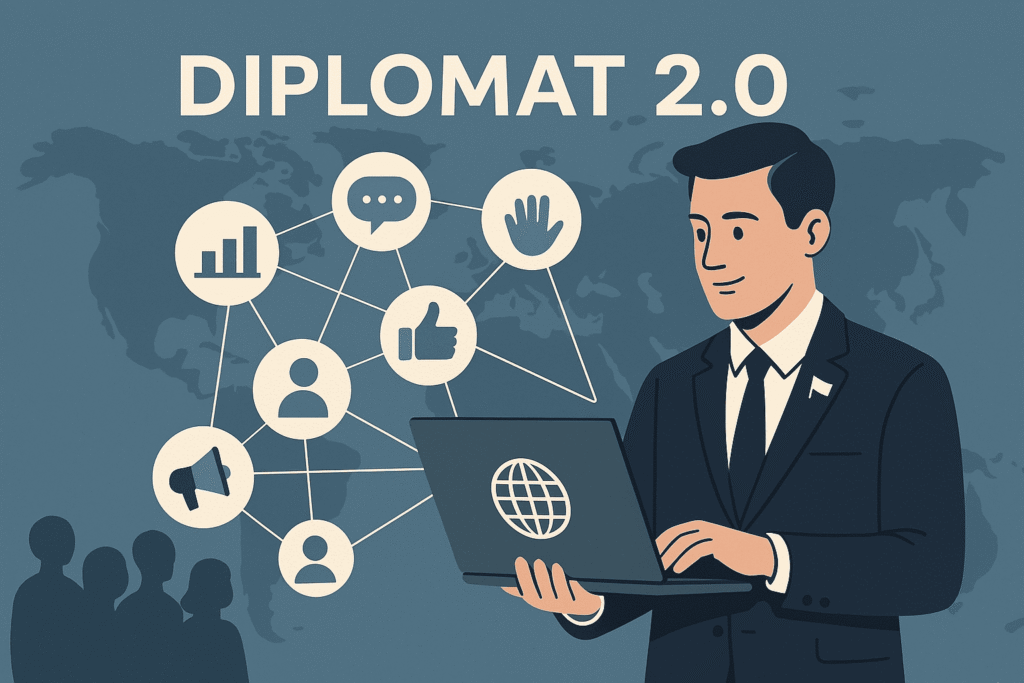
The Scope of Work for a Diplomat 2.0
Their work includes creating digital narratives. They participate in global online debates. They also promote national or institutional interests through digital means. Managing reputational crises in real time is another key task.
Furthermore, they must be trained in emerging technologies. This includes blockchain and artificial intelligence applied to diplomacy. Diplomatic cybersecurity and digital governance are also essential areas of expertise.
The raison d’être of this new actor lies in the fact that diplomacy is no longer exclusively reserved for States. Micronations, unrecognized entities, global corporations, NGOs, international organizations, and digital communities actively participate in the diplomatic game, defending interests, building alliances, and generating global influence. Therefore, the Diplomat 2.0 is, above all, a bridge-builder: between States and citizens, between the physical and digital worlds, between traditional structures and emerging models. They navigate official scenarios and digital ecosystems with ease, understanding that influence today is multichannel, transversal, and real-time.
Diplomat 2.0 thw strategic anomaly
This figure emerges as a “strategic anomaly” in a world governed by state norms, power hierarchies, and formal protocols. They do not respond to an official appointment under public international law, nor do they act under the protection of multilateral conventions. However, they perform substantive political functions: representing, negotiating, raising awareness, articulating, and defending the interests of a collective or territory before international actors, operating from the margins of the formal system. It is not a legal category, but a political figure with flexible forms but a clear purpose: to exercise international representation.
The Historical Necessity of Stateless Diplomacy
Diplomacy, in its essence, is not exclusive to recognized States. Throughout history, communities, peoples, liberation movements, and social organizations have sought international interlocution long before consolidating—or without ever having done so—as recognized States. Historical examples such as the African National Congress (ANC) during apartheid in South Africa, the Palestine Liberation Organization (PLO), or the Tibetan government in exile, demonstrate that diplomatic action does not depend on formal recognition, but on the imperative need to represent a cause and articulate it strategically on the international stage.
In fact, in many cases, Diplomacy 2.0 precedes state recognition, paving the way for future forms of sovereignty or autonomy. It is a diplomacy of resistance, visibility, and the construction of narrative legitimacy. This ability to act from the margins, building bridges and narratives, is what confers critical importance to this role today.
Profiles and Key Functions of the Diplomat 2.0
Although there is no single way to be a Diplomat 2.0, common traits can be identified that define this indispensable figure:
- Representation without recognition: A Diplomat 2.0 represents an actor—a territory, government, community, or cause—that is not officially recognized by most States or multilateral organizations. Despite this, they undertake the mandate to speak on their behalf, seek alliances, and project their collective identity.
- Non-institutionalized political function: These diplomats lack access to embassies, immunities, or bureaucratic structures. Their functions are mobile, creative, and often informal. They represent without credentials, dialogue without protocol, and negotiate without a seat at the official table.
- Hybrid and multifaceted profile: They can be political leaders, community leaders, activists, academics, artists, communicators, or cultural representatives. Diplomacy 2.0 is often exercised from multiple fronts, combining the political with the symbolic, the technical with the emotional.
- Legitimacy from below: Unlike traditional diplomats, whose authority emanates from the State, the Diplomat 2.0’s legitimacy comes from their community, the cause they defend, their coherence, and their capacity for international interlocution.
The main functions that these actors typically fulfill in their unofficial diplomatic work, and which underscore the vitality of their mission, include:
- International political articulation: Connecting the cause they represent with relevant international actors, agendas, and processes, such as multilateral organizations, NGOs, regional networks, social movements, or think tanks.
- Narrative advocacy: Promoting a political, historical, and cultural narrative that challenges the dominant version of a conflict, territory, or people. In contexts of invisibilization or criminalization, narrative is power, and the Diplomat 2.0 is the architect of that narrative.
- Building symbolic legitimacy: Through speeches, symbols, events, art, or ceremonies, they project the existence and dignity of their cause, even without institutional backing. The symbolic makes up for the lack of formal recognition, creating a moral and social basis for their action.
- Informal and institutional negotiation: Managing agreements, support, or alliances through unconventional, often discreet, channels with actors willing to listen or collaborate, even without official endorsement.
- Cultural or emotional diplomacy: In many cases, their role is exercised from culture, historical memory, art, or spirituality, activating bonds from identity and humanity, not just from politics.
Challenges and Opportunities: Navigating the Periphery of the System
Exercising diplomacy without recognition entails permanent tensions and significant structural challenges, which, however, also open doors to strategic opportunities:
Structural challenges of the Diplomat 2.0:
- Institutional invisibility: Most international forums have strict admission criteria, forcing the Diplomat 2.0 to operate in parallel spaces, with strategic creativity to gain visibility without being immediately rejected. However, many Diplomat 2.0s are politicians, leaders of liberation movements, or former career diplomats—prepared individuals with international contacts developed over the years.
- State hostility: In many cases, States that deny recognition, especially imperialistic, colonialist, and dictatorial ones, criminalize or persecute those who perform diplomatic functions on behalf of an unofficial cause, which can involve real personal and political risks.
- Limited resources: Lacking state funding, diplomatic tasks often depend on solidarity networks, self-management, or limited international support, requiring management skills, prioritization, and resilience.
- Permanent ambiguity: The Diplomat 2.0’s position is ambiguous by definition: they represent, but not officially; they speak, but cannot always be quoted; they participate, but rarely vote. This ambiguity can be a source of frustration or, if managed properly, a tactical tool.
Despite these adversities, Diplomacy 2.0 also opens up opportunities that traditional diplomacy cannot explore, including new commercial alliances:
- Participation in informal forums, parallel summits, or citizen spaces, where States do not always have a leading role.
- Access to public and media sympathy, especially if the cause represents universal values such as human rights, self-determination, or historical justice.
- Ability to project more human, less bureaucratic discourses, which can generate greater emotional connection with diverse audiences.
- Transnational solidarity networks, often more agile and committed than formal diplomatic structures.
What a Diplomat 2.0 Is NOT: Clarifying the Essential Role
To fully understand the importance of this figure, it is crucial to clarify what a Diplomat 2.0 is not:
- They are not an improviser: Although they do not act from a formal structure, their work must be professional, strategic, and ethical.
- They are not a unilateral spokesperson: They must maintain a constant link with their community or collective, be accountable, and act with legitimacy from below.
- They are not a provocateur: Their task is not to confront for the sake of confrontation, but to open spaces, build dialogue, and position their cause intelligently.
- They are not a depoliticized actor: Even if they act in cultural or symbolic realms, they do so with political intentionality, representing collective interests.
The strength of the Diplomat 2.0 does not lie in the position they hold, but in the cause they defend and the way they make it visible to the world. This demands ethical firmness, contextual intelligence, narrative ability, and interpersonal tact.